
No, homes aren't more expensive because they are larger than they used to be.

As with yesterday’s post, this is another point which I have made before, but I think maybe I have some fresh visuals that can help settle the case. Right-wing pundits are still making the assertion that homes are just more expensive than they used to be because they are larger than they used to be.
It’s depressing that this is such a cherished assertion on the right, because the solutions to the problem of housing affordability generally involve deregulating supply. These are pundits and policymakers that would naturally be on the correct side of that argument. And, instead, they engage in these ridiculous mis-readings of the data, they entertain fallacious narratives about how the Federal Reserve affects mortgage rates and home prices, and they treat every originated mortgage to a borrower with less than an 820 credit score as some sort of government subsidy. So, on the most important long-term problem that free markets can fix, its defenders are fighting for it like Everett Ulysses McGill.
Of course, at the other end of the political spectrum, there is a common ailment to be congenitally opposed to markets. The lack of markets in housing has very regressive economic effects - it makes poor families poorer. But some argue that the housing affordability problem is caused by poverty, being unable to see that the poverty is caused by the lack of markets.
The growing YIMBY movement and Abundance movement have to build from the middle outward since the ends of the political horseshoe are so incapable of understanding and addressing this issue.
One can understand how right-wing pundits have this reaction against the left-wing claims, because the left-wing claims are off-base. The problem isn’t poverty making housing less affordable. The problem is that housing is causing poverty. So, I can see how there is a motivation to push back and to say that, no, actually, we don’t have a poverty problem. That reaction is correct. But, until they stop being confused about housing, they are going to twist that correct reaction into an unhelpful intransigence.
I don’t think these outdated assertions about the state of housing affordability are going to go away, but, maybe, just maybe, the starkness of the reality, which I have tried to lay out in the charts below, can help remove the scales from the eyes some members of the audience of the pundits with the outdated assertions - to help move them to the middle where YIMBY and Abundance reforms eschew the errors of the ideologues.
There are a few intermingling claims that are repeatedly asserted - households have been getting smaller, homes have been getting larger, and so if households are having trouble affording housing, they could just live in homes like the ones their parents and grandparents lived in and stop their bellyaching.
Invariably these claims will cite housing conditions in 1970, or thereabouts. The reason they cite dates that old is because the story they are telling hasn’t been true for 30 years.
On to the pictures. But, first, one caveat. I am using the average square footage data for all types of homes from the Census Bureau’s Quarterly Completions by Purpose and Design. This is only for new homes. Sometimes when analysts use this data, I complain about that because in any given year new homes are only a very small portion of the stock of housing. And, the shortage specifically causes the cost of older homes to increase the most, so, using new home price data is sometimes mis-used to claim that there isn’t a housing cost problem. While the unchanging existing homes inflate in place, homebuilders make a lot of decisions about where to build, what to build, etc., to keep prices of new homes lower. One obvious issue is that the cities that have become the most expensive - NYC, Los Angeles, etc. - are expensive specifically because home builders can’t build there, so the most expensive cities basically don’t show up in the new home price data.
But, that’s the best data we have on home size, so it’s what I have to use here, and I don’t think it causes any biases favorable to my point.
On all these figures, the x-axis will be the aggregate value of all residential real estate as a multiple of aggregate US personal income. Household size and home price/income data is available from 1947 to the present. Square footage data is available from 1974 to the present.
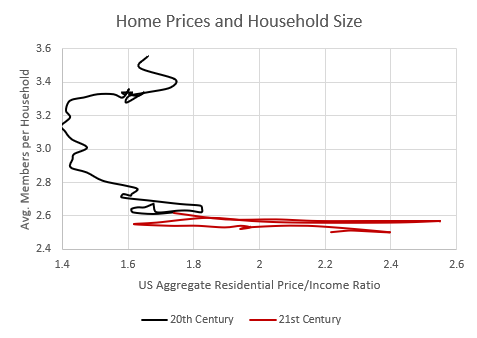
The y-axis in Figure 1 is the average members per household. In the 20th century, the size of the average household declined sharply. That required building a lot more homes per capita. And while we were doing that, the aggregate price of homes remained flat - between 1.4x and 1.8x aggregate personal income.
In the 21st century, household size stabilized and home prices jumped from 1.6x to 2.5x aggregate personal income.
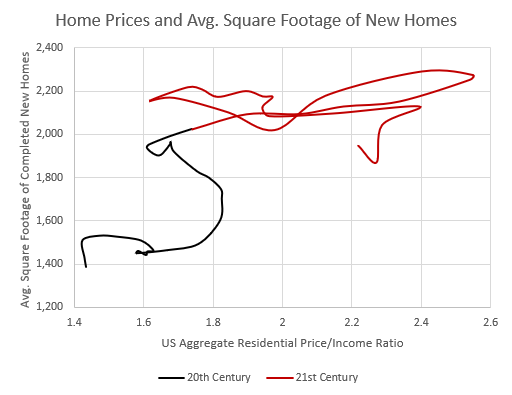
In Figure 2, the y-axis is average square footage of new homes. From 1974 to 2000, that jumped sharply from 1,400 square feet to 2,000 square feet while home prices remained between 1.4x and 1.8x personal income. Today, the average size of new homes is less than 2,000 square feet and price/income is above 2.2x.
Finally, the y-axis in Figure 3 is square feet per household member. From 1974 to 2000, that increased sharply from 467 square feet to 772 square feet. Aggregate home values ranged from 1.4x to 1.8x aggregate personal income. Today, the average square feet of new homes per household member is 780, roughly the same as in 2000.
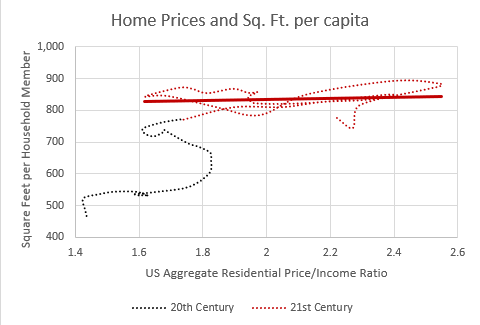
During the 20th century, new homes got much larger with no strong effect on price/income. In the 21st century, homes have become much more expensive in a way that has absolutely nothing to do with how large they are.
In some way, surely, building smaller homes should make them more affordable. These false assertions have such staying power because it seems like that statement is a truism. But, homes are necessarily paired with land, and the reason we have a housing crisis is because obstructions to building and funding housing have been so binding, that the premium families must pay for the land under the homes has been outpacing our ability to shrink them through changing the composition of new homes. What seems like a truism is actually very much not true. It is unrelated to our problem. And the assertions based on it are so wrong that it would be true to call them lies.