


Household Size and the Housing Stock

A common claim from supply truthers is that homes per capita is at all time highs, so there can’t be a supply crisis. For some number of reasons, a lot of people are just resistant to the supply story. To someone seeking anti-supply talking points, it seems like a really good point. I have written a little bit before about why it really isn’t an informative piece of evidence.
One thing you’ll commonly see is a chart like Figure 1. It only extends from 2000, and the y-axis is very truncated. Figure 1 represents about a 5% range in scale.

Here, I want to go into household size. Household size is basically the flipside of homes per capita. Household size declined sharply from the 1960s through the 1980s. A small portion of that was due to more adults living alone, but almost all of it was due to fewer children (Figure 2).
Also, you can see here how Figure 1 truncates the y-axis. Average household size is basically the reciprocal of homes per capita. You can see here that if Figure 1 was extended to the 1970s, it would look like a flat line since the 2000s. Though, still it is true that homes per capita is at an all time high and average household size is at an all time low.

Basically, adults were becoming a larger portion of the total population, so we had to expand the housing supply much faster than population growth because children live, dorm style, with their parents, and adults generally live on their own or with a spouse.
Figure 3 shows the number of new homes (both completions on-site, and manufactured homes shipped) annually, as a percentage of the existing stock of homes. Population growth was about 1% for the whole period from 1965 to 2008, but from the 60s to the 80s, the housing stock was being expanded by 2% or 3% annually to house all those extra households.
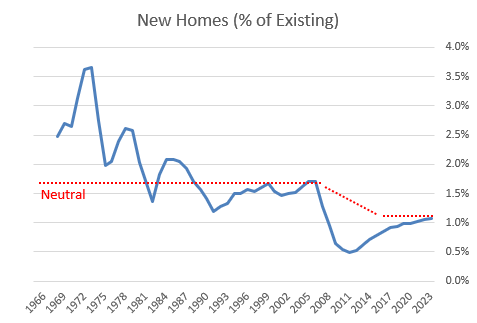
After 2008, population growth dropped to about three-quarters of a percent for a few years and then after about 2016, dropped again to about a half percent. Then it dropped to nearly zero during the pandemic. It has recovered back to about a half percent, and with strong demand for immigration, that seems like it is likely to persist for a while. (Obviously there is big talk about that in the presidential campaign. I’m not oblivious to that, but I’m not going to go into that here.)
So, the big numbers of housing production in the 1970s were sort of a one-time spike of demand that can’t really happen again and that doesn’t need to be repeated. On the other hand, the chart makes clear how ridiculous the 2000s bubble stories are. The housing glut thesis that was canonized was completely unempirical. There is nothing in the history of housing markets to suggest that there is some tipping point where demand becomes inelastic in an oversupplied condition. And if there was, there was nothing about production levels in 2005 that would have triggered such a condition. Americans believed something that couldn’t possibly be true, and the economics profession, as a whole, was useless as a corrective.
There was already a regional dearth of housing before 2008, but even with the decline in population growth, the lack of production after 2008 created a sizeable national shortage that private forecasters massively undercount. The JEC estimated the shortage at 20 million units, which is about where I would put it.
But, wait, if we are short 20 million homes, then how can homes per capita be at all time highs?
Homes per capita is at all time highs because a lot of the drop in household size, even recently, was from having fewer children, as shown in Figure 4.

Household size levelled off in the 1990s, and so it has become common for it to be treated as a measure that reverts to a constant. Obviously, historically, in the US, it hasn’t been remotely constant, and internationally, it also changes over time more often than it is stable. This is a statistical error. If your model conclusions depend on assuming a constant level of homes per capita then your model isn’t going to be able to tell you anything about supply conditions.
Also, these household size numbers are based on occupied units. Vacant homes don’t contain a household, so they don’t affect the average household size metric. But, since 2008, vacancies have been declining steeply. Lacking adequate new construction, we have been harvesting vacant units. Vacancy rates are basically down to the minimum functional level now, so there isn’t much more to be utilized there.
In Figure 5, using Census HVS data, I estimate homes per capita, including vacant homes. The “Persons per Occupied Home” and “Adults per Occupied Home” measures are the measures from the household size data above. The “Persons per Home” and “Adults per Home” measures are homes per capita estimates that include vacant homes.
(You might notice that persons per home has moved up slightly in this chart, even though earlier I wrote that persons per home was at an all-time low. In these charts, I estimated population with Census data from table HH-6. Figure 1 used BEA population estimates. The differences are minor. As I mentioned above, the scale used in Figure 1 is very tight and amplifies very small changes.)
Richer economies have tended to have fewer children. But, richer economies also tend to have more vacant homes - second homes, vacation homes, homes rented to travelers, etc. A lot of the supply truther discourse singles all those uses out. “We don’t have a supply problem. If we tax vacancies, keep foreigners from buying pieds-à-terre, and ban Airbnb’s, we’d have plenty of homes.” Those complaints tend to be made with a tone that is in objection to supply-centered narratives, but they really are confirmations of the point that we lack supply. Really, they aren’t economic arguments. They are cultural arguments. They are simply steps in the process of authoritarian control that would be necessary to maintain the housing deprived status quo. To keep the built environment from changing, we need to keep restricting more groups who would use it.

It’s a reactionary cultural argument masquerading as economics. As I have mentioned before, Phoenix, throughout its history, has contained a large number of seasonally vacant homes. Phoenix grew quickly for decades, when new homes were built at a scale that kept the entire valley affordable. Now that we have cut down many avenues for building, vacancies and alternate uses will naturally be a target for blame, but they’ve been here all along.
There is no feasible future with affordable housing that doesn’t also include a lot of new vacant and seasonal homes and homes used lightly by people of means. Those who aim for the path that includes affordable homes but not other homes will always object to the changes that will be necessary to create affordable housing for working class Americans. Some of them are cynically motivated, some are deceived, and some are sincere ideologues. It doesn’t really matter which they are. If they think housing will become more abundant and affordable by blocking the wrong kinds of it, they will inevitably not be helpful.
Anyway, on the homes per capita numbers in Figure 5, you can see that persons per home and adults per home both continued to decline through the 2000s. Then, persons per home levelled off and adults per home actually started to rise.
In the y-axis scale of Figure 2, adults per household looks basically flat. But, in Figure 6, I focus on just that number, with a tighter scale. Adults per household (or adults per occupied home) and adults per home (either occupied or vacant). Have actually changed quite a bit.
In Figure 5, you can see that even adults per household has risen since 2008. So, homes per capita is at all time highs because of the declining number of children. Adults per household bottomed at 1.91 and has increased up to 1.96. In other words, homes per adult is not at all-time highs.
Returning adults per occupied home to 1.91 would call for about 4 million units itself.
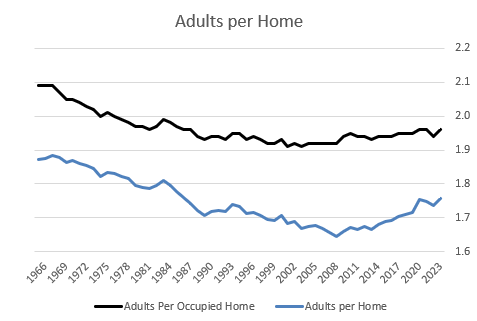
But, remember, many of the new households were occupying formerly vacant units. Vacancies are far too low now. Adults per home bottomed out at about 1.65 and has risen back up to 1.76. Getting that back to the pre-2008 level would require about 11 million homes.
But, again, neither adults per household nor adults per home was stable. Adults per home had a pretty linear 40-year downslope that would, by now, be below 1.6 adults per home if those trends had continued. And it would take about 20 million more homes to get in that ballpark.
A lot of those homes would probably be Airbnb’s, seasonal retirement homes in the south, second homes, etc. Being against that is just being against change, progress, shared affluence, and human flourishing. And, in practice, we won’t even get adults per occupied home back down to the pre-2008 level if we try to do it by opposing all the “wrong” kinds of housing. There really are two very different sides here. The choice between them is not subtle. You can support a return to affordable housing by supporting all kinds of housing. Or, you can block a return to affordable housing by blocking affordable housing. Or, you can block a return to affordable housing by blocking the “wrong” types of housing.
We are already 15 years into a cultural and economic battle that is so important, it turned the direction of adults per house upward for, likely, the first time since the start of the industrial revolution. Fifteen years in, by that measure, we have reversed economic progress by nearly 40 years. There is so much ground we have to make up. And, also, the reactionary position will have to continue to dig deeper and get worse - rounding up immigrants, blaming the homeless, stoking fear and distrust of financial institutions. I’m sorry if I’m sounding too shrill. It all happens in slow motion around us, so we adapt to the new normal. But the tent encampments in all the urban parks are a long way from what should be considered normal. We are already deeply into a cultural battle. And you can see that it is a cultural battle, because it is difficult to simply establish a plurality of support to admit obvious things.
If this continues, it will destroy the fabric of mutual trust that has managed to miraculously hold this country together for 250 years. The challenge is to open the eyes of enough victims of these policy choices that 50%+1 of the country can address it on the empirical level rather than the aesthetic level, and to stop this devolution before it gets worse.
You're not being shrill--the math is solid on this and the fundamental demonstration is the way in which all housing unit prices have appreciated at a higher rate than CPI over the last several decades. My personal metric is the resale value of "junk" houses on the outskirts of metro areas---these assess and sell for prices that don't make sense unless you account for the broad based scarcity of housing units everywhere. I happen to own one of these s--theaps and if I sold it I'd make a profit because someone will be desperate enough to buy it even if I don't fix the plumbing, electrical, septic, siding, kitchen, bathroom, etc.....
You quip on Twitter that reacted to the Marginal Revolution comments section was cynical and accurate. The path to housing abundance is all uphill everywhere.
A non-PC comment:
This guy says there are 20 million illegal immigrants in the US.
https://thehill.com/opinion/4423296-matthews-illegal-immigrants-double-under-biden-and-thats-just-the-start/
Others say about 11 million illegals in the US, although that is a bit of an aging number, and most think tanks/academics tend to be liberal-globalists, and underplay any problems with immigration.
(Three-quarters of econ grad students in the US are foreign-born...which might also lead to biases).
So, if the US is short 10 million housing units but has 20 million illegals...
Housing in Japan is affordable, in part due to stable, or slowly declining population. Similar to regions of the US with slowly ebbing populations.
Rents in Sapporo about $400 a month for a unit in Los Angeles that costs about $2,400 a month.
People in Sapporo have higher living standards than people in Los Angeles.